Why our hair changes during perimenopause and what really helps (vs internet myths)
From Hanneke’s diary
‘Have you been using a curling tong?’ a friend asked during dinner. She wasn’t the first to notice. Even my sister had recently commented on the spontaneous waves in my hair. My hairdresser had also picked up on it.
‘Your hair is getting curlier. It’s probably the hormones.’
At first, I laughed it off. But then it hit me out of nowhere: help! The menopause was starting. My two sisters had both been 48 when it began for them, my mum had been 48 and now it was my turn.
With my hair freshly dyed to cover the emerging ‘platinum highlights’, I reflected on recent events…
‘Now that you’re 50, I have a piece of advice for you,’ my hairdresser said. ‘Go for a short haircut.’
‘Huh, why?’ I asked, taken aback.
He was firm. ‘Your hair is thinning.’
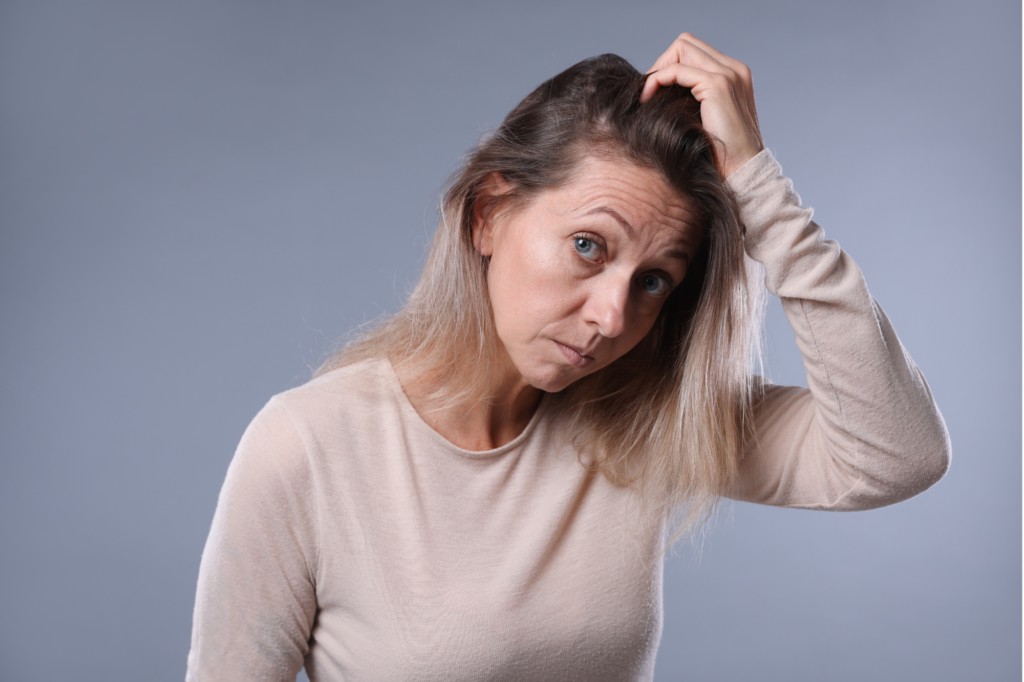
I had already noticed this. Lately, I’d been pulling out handfuls of hair.
‘Yes, the hair on my head is getting thin and limp, while my beard is growing thick and coarse,’ I joked.
‘Long hair drags your face down. Everything is already sagging,’ he winked. ‘Short hair lifts you up and gives a perkier look.’
I had to swallow hard. I really was getting older. Even my mother had subtly hinted, ‘Hanneke, maybe it’s time to try something different with your hair.’
‘Go ahead,’ I said. My long locks fell to the floor.
‘It’s a form of letting go,’ my hairdresser explained. ‘They say that cutting your hair also helps you leave a significant part of your past behind.’
The thinner my hair got, the more expensive my hair products became. From a five-pound bottle of mousse to ‘Sucre du Paraguay’ — 29 pounds for a very small bottle. It was absurd, but I did it anyway.
Short hair only has two modes: chic or frumpy – just trying to make the best out of it… most days 😉
💜
Love, x
x
Hanneke’s story may sound familiar. The shedding, the sudden appearance of platinum highlights, maybe even the curls. But what is actually happening beneath the surface of the scalp?
Hair, Hormones & What’s Really Going On
Hair changes during perimenopause are incredibly common, even if we don’t always talk about them openly.
As oestrogen levels decline, the balance between oestrogen and androgens (male-type hormones that we all have) shifts. Oestrogen helps keep hair in its growth phase (the anagen phase) for longer. When levels drop hair grows more slowly, more hairs enter the resting and shedding phase, strands may become finer and texture can change.
Research in dermatology shows that female pattern hair thinning often increases during the menopausal transition (Sinclair, 2005). It tends to be gradual and diffuse, not bald patches, but a quiet reduction in density.
At the same time, relatively increased androgen sensitivity can lead to coarser hair on the chin or upper lip. The irony is not lost on any of us.
Why It Feels Bigger Than “Just Hair”
Hair carries symbolism. Youth. Femininity. Vitality. Identity.
So when it thins, changes colour or texture, or refuses to behave, it can feel deeply personal, even if no one else notices.
What Actually Helps (Without Falling for Miracles)
There is no oil that reverses menopause. But there are sensible, science-informed ways to support your hair. Here are some approaches that may help – and a few thoughts on what might just be a hype.
1. Adequate protein
Hair is largely made of keratin, a structural protein. Severe protein deficiency can cause shedding. While most women are not deficient, ensuring adequate daily intake, especially during midlife, supports overall tissue health.
(If you’d like to read more about that, I explored it in my previous blog on Protein, Perimenopause & Power.)
Position papers on ageing and nutrition suggest midlife and older adults may benefit from a slightly higher protein intake to support tissue maintenance (Bauer et al., 2013).
2. Check iron, vitamin D and thyroid
Iron deficiency is one of the most common reversible causes of hair shedding in women. Thyroid imbalance can also contribute.
I personally know that my iron levels tend to be on the lower end (possibly due to vegetarian diet), so I take a supplement to compensate.
If hair loss feels sudden, excessive, or worrying, it’s worth speaking with your GP and ruling out underlying causes.
3. Rosemary oil, some evidence
A small clinical study found rosemary oil performed similarly to 2% minoxidil over six months (Panahi et al., 2015).
The key word here is oil, not shampoo. If you’re curious, a diluted rosemary essential oil (2-3 drops in tablespoon of light olive oil, for example) applied to the scalp and left 30-60minutes before washing is more aligned with the evidence than a rinse-off product. Results take time, and consistency matters. And it won’t work overnight.
NB: Always patch test first, and stop in case of irritation.
4. Biotin, only if deficient
Biotin is often promoted for hair growth. Severe biotin deficiency can cause thinning hair and in those cases, supplementation helps. However, true deficiency is rare. For most women experiencing menopause-related thinning, high-dose biotin is unlikely to make a dramatic difference.
5. Gentle handling
During perimenopause, hair can become more fragile. Helpful habits include:
✔ Avoid aggressive brushing, especially when wet
✔ Use a wide-tooth comb on damp hair
✔ Gently squeezing hair dry instead of rubbing with a towel
✔ Use a soft cotton, bamboo or microfiber towel to reduce friction
✔ Use conditioner to reduce breakage (avoid heavy application at the roots if volume is an issue)
✔ Limit daily high heat styling
✔ Ammonia-free dyes may be gentler but don’t prevent hormonal thinning
✔ Micro-trims every 6–8 weeks help hair look fuller
SLS shampoos are not inherently harmful, but can be drying if your scalp is sensitive. Choosing a gentler formula may reduce irritation , though it won’t change hormone-driven thinning.
6. Rice Water: Viral, But Weak Evidence
Rice water has gone viral in recent years. While there’s little strong clinical evidence for hair regrowth, it may temporarily improve shine and smoothness by coating the hair shaft. If you’re curious, simply using cooled leftover rice water as a rinse once a week is harmless for most people. Just don’t expect it to reverse hormonal thinning.
7. Collagen Supplements
Collagen supplements are often promoted for skin, hair and nails. There is reasonable evidence that hydrolysed collagen may improve skin elasticity and hydration. Evidence for hair regrowth, however, is limited. If you enjoy taking collagen for skin support, it may indirectly contribute amino acids for tissue health — but it’s not a substitute for addressing hormonal changes or overall nutrition.
8. Caffeine Shampoo
Caffeine can wake up your brain in minutes. Hair follicles? They’re slower. Some laboratory studies suggest caffeine may mildly stimulate follicles, but real-world effects tend to be modest. If trying, a leave-in product may provide more exposure than a rinse-out shampoo.
There is no magic solution (or shampoo) that stops time.
But there is knowledge.
And there is choice.
And there is the quiet power of adapting with grace.
Sometimes letting go of long hair is not about ageing.
It is about adjusting.
💛
Hasta pronto,
 x
x
For further reading & investigating, click on the following links:
- Bauer, J., Biolo, G., Cederholm, T., Cesari, M., Cruz-Jentoft, A.J., Morley, J.E., Phillips, S., Sieber, C., Stehle, P., Teta, D., Visvanathan, R., Volpi, E. and Boirie, Y. (2013). Evidence-Based Recommendations for Optimal Dietary Protein Intake in Older People: a Position Paper from the PROT-AGE Study Group. Journal of the American Medical Directors Association, [online] 14(8), pp.542–559. doi:https://doi.org/10.1016/j.jamda.2013.05.021.
- Mirmirani, P. (2013). Managing hair loss in midlife women. Maturitas, 74(2), pp.119–122. doi:https://doi.org/10.1016/j.maturitas.2012.10.020.
- Panahi, Y., Taghizadeh, M., Marzony, E.T. and Sahebkar, A. (2015). Rosemary oil vs minoxidil 2% for the treatment of androgenetic alopecia: a randomized comparative trial. Skinmed, [online] 13(1), pp.15–21. Available at: https://pubmed.ncbi.nlm.nih.gov/25842469/.
- Sinclair, R., Wewerinke, M. and Jolley, D. (2005). Treatment of female pattern hair loss with oral antiandrogens. British Journal of Dermatology, 152(3), pp.466–473. doi:https://doi.org/10.1111/j.1365-2133.2005.06218.x.
- Thornton, M.J. (2013). Estrogens and aging skin. Dermato-endocrinology, [online] 5(2), pp.264–270. doi:https://doi.org/10.4161/derm.23872.